
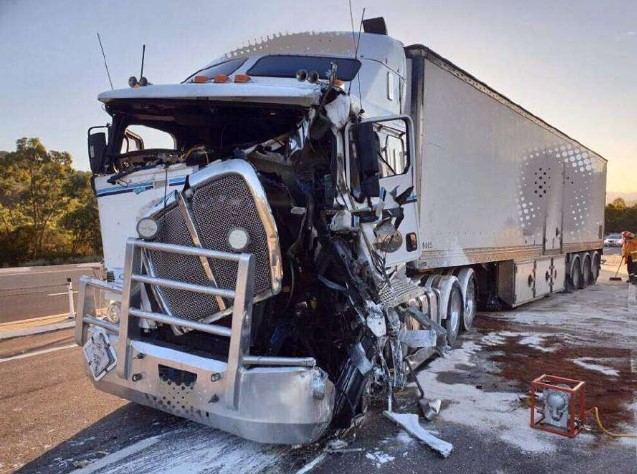
A write-off is a shock, and the paperwork arrives at the worst possible moment. The single most important thing to understand is this: the vehicle may be gone, but the loan is still there. If your car is written off and you still owe finance, the insurance payout goes to your lender first, and anything it doesn't cover is still your debt. Here is how that works in Australia, how to calculate any shortfall, and what to do in the first few days.
Key takeaways
- A total loss does not end your loan. You must keep making repayments until the debt is paid out in full.
- If the financier is noted on your policy, the insurer pays the lender first and pays you any surplus.
- Market value cover often pays less than you owe, especially early in a loan or where there is a balloon payment. The gap is called a shortfall.
- Gap or loan termination cover may pay that shortfall, but check its value, exclusions and cost before buying it.
- Business owners should ask their accountant about GST and tax effects, and plan for downtime.
- If you can't meet repayments, ask your lender for help early. Consumer borrowers have hardship rights under the National Credit Code, and AFCA can hear disputes.
Your loan doesn't disappear with the vehicle
A car loan, chattel mortgage or hire purchase agreement is a contract to repay money. The vehicle is the security for that contract, not the contract itself. When the security is destroyed, the lender's protection is gone but your obligation to repay is unchanged. Until the lender receives a full payout, interest keeps accruing and repayments keep falling due.
So the instinct to stop paying because the car is gone is the most expensive mistake you can make. Missed repayments can be recorded on your credit report, attract fees and, if they continue, lead to a default listing that affects your borrowing for years.
How the insurance money reaches your lender
When you finance a vehicle, the lender almost always requires comprehensive insurance and asks that it be noted on the policy as an interested party (sometimes called the financier or loss payee). If the insurer declares the vehicle a total loss, it will usually:
- Assess the claim and confirm the settlement amount under your policy, less any excess and sometimes less any unpaid premium.
- Request a payout figure from your financier.
- Pay the financier up to the amount needed to clear the loan.
- Pay any remaining balance to you.
The insurer generally keeps the wreck (the salvage). If the settlement is less than the payout figure, the remainder stays owing by you.
Who owns the vehicle depends on the product
The type of finance changes the paperwork, not the outcome. With a consumer car loan or chattel mortgage, you own the vehicle and the lender holds security. With hire purchase, the financier owns it until the final payment. With a finance lease or novated lease, the financier owns it and the lease usually sets a termination amount payable on a total loss. Read the "total loss" or "early termination" clause in your contract. Our guide to types of business finance in Australia explains these structures in more detail.
Market value vs agreed value: the clause that decides the outcome
Comprehensive motor insurance in Australia is usually written on one of two bases. Which one you chose when you took out the policy largely decides whether a shortfall appears.
Market value cover
The insurer pays what the vehicle was reasonably worth immediately before the accident, typically using comparable sales and valuation guides adjusted for kilometres, condition and options. Market value generally falls over time. Premiums are often lower, but the payout is uncertain until the claim is assessed.
Agreed value cover
You and the insurer agree on a fixed sum when the policy starts or renews. On a total loss, that is the amount paid (less excess), regardless of what the market is doing. Premiums are often higher, and the agreed value usually steps down at each renewal, so check it every year.
| Feature | Market value | Agreed value |
|---|---|---|
| Amount paid on total loss | Assessed at claim time | Fixed sum set at start or renewal |
| Certainty | Low: depends on the market and assessment | High: known in advance |
| Typical premium | Often lower | Often higher |
| Shortfall risk on a financed vehicle | Higher, especially early in the loan | Lower, if the agreed value tracks the payout figure |
| What to check | How value is assessed and disputed | That the agreed value is realistic and reviewed each renewal |
The shortfall: a worked example
A shortfall happens because vehicles often lose value faster than a loan is repaid, and because a balloon (residual) payment keeps the balance high throughout the term.
Example (illustrative only): you borrow $42,000 at an illustrative 9.5% p.a. over five years (60 months). The monthly repayment is about $882.08. After 18 repayments, the outstanding balance is about $31,412.96. The car is written off and, under a market value policy, the insurer assesses it at $26,500. After a $1,000 excess, it pays $25,500 to your lender.
- Outstanding balance: $31,412.96
- Insurance paid to lender: $25,500.00
- Shortfall you still owe: $5,912.96
Now change one assumption. If the same loan had a 30% balloon ($12,600) due at the end, the monthly repayment drops to about $717.20, but after 18 months the balance is about $34,589.07. The shortfall with the same insurance payout grows to $9,089.07. Lower repayments today mean more exposure if the vehicle is lost.
| Scenario (after 18 months) | Loan balance | Insurer pays lender | Result |
|---|---|---|---|
| No balloon, market value $26,500 | $31,412.96 | $25,500.00 | Shortfall $5,912.96 |
| 30% balloon, market value $26,500 | $34,589.07 | $25,500.00 | Shortfall $9,089.07 |
| No balloon, agreed value $33,000 | $31,412.96 | $31,412.96 | Surplus of $587.04 paid to you |
| 30% balloon, agreed value $33,000 | $34,589.07 | $32,000.00 | Shortfall $2,589.07 |
Balances are calculated with the standard amortisation formula and ignore fees. A real payout figure may also include accrued interest since the last repayment, early termination or break costs, and any arrears, so always ask the lender for a written payout figure dated for the expected settlement. You can model your own loan using our loan calculator.
Gap cover and loan termination insurance
Several add-on products target this problem. Names vary, but they fall into a few groups.
What these products typically do
- Gap or shortfall cover: pays some or all of the difference between your insurance settlement and the loan payout, usually up to a stated limit.
- Return-to-invoice cover: pays the difference between the insurance settlement and the original purchase price.
- Loan termination or loan protection cover: may pay out or contribute to the loan in specified events such as death, illness or involuntary unemployment, depending on the policy.
Check the value before you buy
ASIC has, over a number of years, raised concerns that some add-on insurance sold through car dealers delivered poor value: high premiums, sometimes financed into the loan so you pay interest on them, combined with low claim payouts and restrictive exclusions. Not every product is poor value, but compare. Ask for the product disclosure statement, the claim limit, the exclusions, and whether the premium is being added to your loan.
The deferred sales model
Since October 2021, a deferred sales model has applied to many add-on insurance products sold in connection with buying or financing a vehicle. In general terms, the seller must give you certain information and then wait a set period before selling you the add-on, so you aren't rushed into it at the point of sale. Some products are exempt, and the rules have detail that matters, so see moneysmart.gov.au for current consumer guidance on add-on insurance.
Buy add-on cover for the gap you actually have, at a price you've compared, and never because it was the last form in the stack.
Uninsured or third-party-only: the hardest scenario
Most finance contracts require comprehensive cover for the life of the loan, but policies do lapse after a failed direct debit, and some borrowers switch to third-party property cover to save money.
If the other driver was at fault
You may be able to recover the value of your vehicle from the at-fault driver or their insurer. If they are uninsured, recovery can be slow and uncertain. Some third-party property policies include limited cover for your own vehicle when an identified uninsured driver is at fault, so check yours. Recovering money from another party is a legal matter, so consider independent legal advice.
If you were at fault or the driver can't be identified
With no comprehensive cover, there may be no payout at all. The full loan balance remains and you have no vehicle. This is the situation where talking to your lender early matters most (see below), and where a structured plan, possibly including debt consolidation planning, may help you manage the remaining debt alongside a replacement vehicle.
Business vehicles and trucks: extra things to consider
For a tradie's ute, a courier van or a prime mover, the same principle applies (the debt survives the asset), with extra layers.
Chattel mortgage and hire purchase
Under a chattel mortgage, your business owns the vehicle and the financier is paid from the insurance settlement. Under hire purchase, the financier owns the asset and its contract will specify how a total loss is settled. Either way, check whether your contract includes a balloon or residual, since that often creates the largest shortfall on commercial vehicles. Our car and equipment finance guidance page explains how these structures compare.
GST and tax adjustments
Insurers commonly ask whether you're registered for GST and what input tax credits you were entitled to; your answer can affect the amount they pay. A write-off may also trigger a balancing adjustment for depreciation, and there can be GST and income tax consequences from the settlement. Speak to your accountant and see the guidance on ato.gov.au before lodging your next BAS.
Downtime and loss of income for owner-drivers
For an owner-driver, the bigger cost is often the weeks without a vehicle. Commercial motor policies sometimes include limited hire-vehicle cover, and some businesses hold separate business interruption or income protection insurance. Check each policy for waiting periods and limits. In the meantime:
- Tell key customers early and agree interim arrangements.
- Price short-term hire against the income you would otherwise lose.
- Prepare a cash-flow forecast for the next eight to twelve weeks.
- If you need a replacement quickly, get recent BAS, tax returns and settlement details ready. Our business loan matching service can help you understand your options.
What to do in the first 72 hours after a write-off
Once everyone is safe, these steps keep the claim moving and protect your position with your lender.

Record the scene and details
If it is safe, photograph the vehicles, damage and road. Collect other drivers' names, registration and insurer details, and witness contacts. Report to police where required.
Lodge the insurance claim promptly
Most policies require prompt notice. Note your claim number and any towing or storage arrangements, as storage fees can mount quickly.
Confirm the financier is noted on the policy
Ask the insurer to confirm the interested party details are correct so the settlement goes to the right place without delay.
Call your lender and request a payout figure
Tell them the vehicle is a likely total loss, give them the claim number, and ask for a written payout figure. Ask how interest and fees accrue while the claim is assessed.
Keep repayments going
Unless your lender agrees otherwise in writing, keep paying. If you can't, ask about hardship assistance straight away rather than missing a payment.
Find your add-on policies
Check loan statements and the original sale documents for gap, return-to-invoice or loan protection cover, and lodge those claims too. They often have their own time limits.
Hold off on a replacement
Wait until you know the settlement amount and any shortfall before committing to new finance.
Working with your lender (and what to do if you can't)
Paying a shortfall
Once the insurance settles, the lender will tell you what remains. You may be able to pay it from savings, agree a repayment arrangement, or in some cases roll it into finance for your next vehicle. Be cautious with that last option: adding old debt to a new loan means paying interest on a vehicle you no longer have, and it increases the risk of a shortfall next time. Our article on how loan term changes what you really pay shows why stretching debt costs more.
Hardship variations for consumer loans
If your loan is regulated by the National Credit Code (generally, credit for personal, domestic or household purposes), you can ask your lender for a hardship variation if you can't meet your obligations. You can ask verbally or in writing. Options can include reduced repayments for a period, a pause, or a longer term, and the lender must respond within set timeframes. Under credit reporting rules, a hardship arrangement may be recorded as financial hardship information rather than missed payments.
Business loans
Business-purpose finance generally isn't covered by the National Credit Code hardship provisions, but many lenders still offer assistance, and those that subscribe to an industry code, such as the Banking Code of Practice, may have commitments covering small business customers. Ask directly.

If you disagree with your lender or insurer
Start with the firm's internal complaints process and keep everything in writing. If you're not satisfied, the Australian Financial Complaints Authority is a free, independent scheme that handles disputes with lenders and insurers, including disputed vehicle valuations and hardship decisions. See afca.org.au for eligibility and time limits.
Protection checklist for financing your next vehicle
Use this list before you sign for a replacement so any future loss costs less. If you'd like a second pair of eyes, contact us for a free loan-readiness conversation.
- Keep the loan amount close to the vehicle's value; avoid rolling in old debt, extras or on-road costs you can pay in cash.
- Think carefully before choosing a large balloon; compare the balance it leaves against likely resale value.
- Compare market value and agreed value quotes, and set a realistic agreed value.
- Review the agreed value at every renewal against your current payout figure.
- Confirm the financier is noted correctly as an interested party.
- Set the insurance premium on a payment method that won't quietly fail; diarise the renewal date.
- If considering gap cover, get the PDS, compare it with alternatives and calculate whether the cost is justified.
- Check whether any add-on premium is being financed into the loan.
- For business vehicles, ask about hire-vehicle or business interruption cover and confirm GST details with your insurer.
Replacing a car, ute or truck in Hobart or elsewhere in Tasmania? Get a free loan-readiness review before you sign.
Explore car and equipment financeFrequently asked questions
Do I still have to pay my car loan if the car is written off?
Yes. The loan is a separate contract from the vehicle. You must keep making repayments until the lender is paid out in full, either by the insurer, by you, or both.
Who gets the insurance money, me or the lender?
If the financier is noted on your policy, the insurer generally pays the lender first, up to the payout figure, and pays any surplus to you. If the settlement is less than the payout figure, you owe the difference.
Can I dispute the market value the insurer offers?
Yes. Gather evidence such as comparable advertised vehicles, service records and receipts for accessories, and ask the insurer to review its assessment. If you're still unhappy, use its internal complaints process and then AFCA.
Is gap insurance worth it?
It depends on the size of your potential shortfall, the premium, the claim limit and the exclusions. It can be useful for a highly geared loan or one with a large balloon, but compare products and consider whether agreed value cover or a larger deposit achieves the same result more cheaply.
Will a write-off hurt my credit score?
The write-off itself isn't reported. What can hurt your credit report is missing repayments while the claim is processed, or failing to pay a shortfall. If you're struggling, ask your lender about hardship options before you miss a payment.
What if my truck was my only source of income?
Check your commercial policy for hire-vehicle or business interruption cover, talk to your lender early about temporary assistance, and prepare a short cash-flow forecast. Your accountant can advise on GST and tax effects of the settlement.